Showing posts with label books. Show all posts

Aug 12, 2010

Review: Shadows Linger


Shadows Linger picks up several years after the end of The Black Company. While time has passed, the plot threads feel just as fresh as when you left them. With the Rebel crushed, the Company’s employment with The Lady seems increasingly uncomfortable. Yet, The White Rose has been reborn, a damning secret held by only a few in the Company. This sliver of light fosters hope in their minds: perhaps they won’t have to choose between two evils.

An improved narrative makes Shadows Linger far more than just the same story again. Now, two stores weave around each other, telling the events from two very different perspectives. In addition of Croaker, we also see events from a parallel perspective thanks to Marron Shed. Instead of being a hard-edged mercenary, he’s a timid, rotund tavernkeep up to his watery eyeballs in debt. His story is the most obviously noir of them all. While staving off debt, he starts collecting the bodies of those frozen to death in the street, and then sells them to the mysterious creatures that inhabit the ominous black fortress in town. Every time he digs his way out of a mess, he makes his hole deeper. While morbid, Shed's development from a cowardly scumbag to something of hero makes the entire journey worth while.

Shed does more then just provide a contrasting plot line, but it also allows us to view the Company from the outside. Shed (whom we observe third person, not first) shows us the defects and colorations in Croakers vision. To Shed, these men are brutal and cunning thugs with secret goal, yet to Croaker, they are desperate men just trying to get the job done. This was something that you might have suspected in the first book, but never got to see.

The narrative concludes astoundingly. Cook continues his fantastic pacing, cutting off events right before you’d expect them too. It’s really hard to explain exactly what I loved so much about Shadows Linger without giving away plot points, but rest assured it's incredible.

Character development makes Shadows Linger better then it’s predecessor. Time has passed since we’ve seen our mercenaries last. Time has been hard on them, and their development doesn’t just change them, it deepens them. These are the kind of characters that season well over time, developing creases and wrinkles. 

But it doesn’t stop there! Just like with The Black Company, Shadows Linger wraps up enough threads to be satisfying, but leaves enough dangling to cause you to dive straight into the next one.

Aug 11, 2010

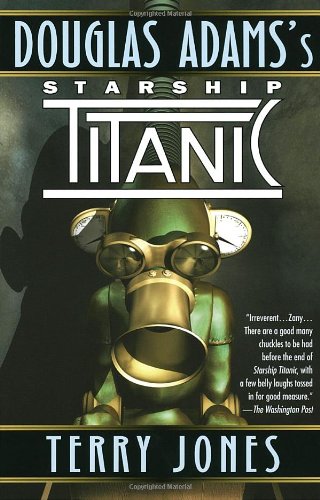
Douglas Adam's Starship Titanic Review


The classic Douglas Adam didn’t always write books. The Hitchhiker’s Guide to the Galaxy actually started as a long-running radio play before the book was written. He also did a few text-based adventure games for Infocom, including the utterly amazing Bureaucracy. When the landmark Myst released, Adams dreamed of doing a similar game, but with conversations (as Myst was eerily silent). The result was Starship Titanic.

While the novelization of said game may be have “Douglas Adams’s” on the cover, the apostrophe warns us that it’s actually authored by someone else, in this case ex-python Terry Jones, himself a master of the dry British wit. 

The Starship Titanic herself is a ultra-mega cruise liner, whose construction was so expensive and extravagant that it bankrupted the economy of an entire planet. The debacle continues until it suffers a Spontaneous Massive Existence Failure on its maiden voyage, only to land on some poor earthling's house. To compensate them for their loss, the occupants are given free tickets, and it all unfurls from there, much like a what happens when you tug on a loose thread in a sweater (for the characters more so then the readers).

To his credit, Jones does a great job of keeping Adam’s rhythm. The bizarre observations and metaphors remain and in true Adam’s fashion, often the most hilarious part is simply the method of writing itself. If you enjoyed Adams' writing, you'll enjoy Jones mimicking. 

The downfall of Adams later books was the plot tried too hard and the humor became too bitter. While Starship avoids this, it develops its own issues. Starship Titanic’s issue is largely the blandness of the characters. Little develops about them until the end, and even then they seem more all to “regular”. Compared to the bizarre cast of Hitchhiker, they really don’t hold a candle. I kept imagining a Zaphod, Ford, Marvin or Dent to walk in and steal the scene, but they never showed up.

Adam's Python Cameo
While the first two Hitchhiker books are as highly recommended as they come (I find myself quoting them verbatim often), I can only recommend Titanic to Adams fans. It’s better than Mostly Harmless, but it’s far short of The Restaurant at the End of the Universe.

The most awesome part of this whole deal is that it connects Adams deeper in British culture. Not only did he write a Dr. Who episode and star in a two-second cameo in a Flying Circus skit, and named the final Pink Floyd album, but a Python wrote the novelization of one of his games. That just makes me geek out.

But seriously, go play Bureaucracy. You’ll need a walkthrough, but it’s almost his best work. You can even read it here, which is just as funny. Just experience it somehow.

Jul 29, 2010

Review: The Black Company by Glen Cook

Glen Cook’s titular company of black is a band of hardened mercenaries. These rough, near-villain men fight for the highest bidder, honor-bound only to their contracts. Cook shows (not tells) the exploits of these storied band of mercenaries, though the eyes of their medic and annalist, Croaker.

The Black Company has a thematic styling that you’re more likely to find in detectives and murder mysteries then a high fantasy tale. There are no shining knights pitted against evil wizards here. Instead of stark black and white, the Black Company wades waist-deep in grey.

The Lady, a mysterious and likely entirely evil being, dominates most of the world. By accident, the Company finds itself in the employ of a Taken, one of the Lady’s powerful henchmen.

Any moral qualms they might have had are calmed when they see the brutality of the rebels. The Black Company might be caught between a war of two evils, but they always honor their contracts. Well, most of the time at least.

The noir elements resound throughout almost every element of the plot. Not only is the company forced into an evil vs. evil conflict, but Croaker falls into a fatal fascination with the Lady herself. However dark things get, it never goes pitch black. Eventually, they catch a break, even if it’s at the expense of someone else; the silver lining is always tinged with bitterness.

Croaker is an interesting character to view the events of the book through. Cook gets you deep in his battle-worn skin.  You might not agree with him, sometimes he might repulse you, but you understand and empathize with him.

The sparse writing leaves many spaces for interpretation. Often, Croaker will decide not to record certain facts, or admit to not telling the full story. He’s surprisingly reliable, but there’s the sense of being told the story second hand. You’ll also find no maps in The Black Company, leaving most of the geography up to your imagination and the few sparing details. Cook is very much telling a human story instead of world building.

I’m forced to compare him to Steven Erikson, as he’s the only other non-Tolkien-esque fantasy author I’ve read. When stood against Erikson, Cook is far narrower in focus. All we see of the world is what Croaker sees and knows. Ancient histories are reduced to rumors, and the writings of dead cultures are indecipherable more often than not. Yet, this small window into a great world tantalizes more then it frustrates.

While the style may be lacking in details, The Black Company is more then intriguing enough to quickly pull you through the entire volume (and it’s sequels) in no time at all.  Cooks pacing is excellent; the moment when you think you’re about at the end of a thread, a dozen more threads of intrigue appear for the observant reader.

The Black Company is not a pretty book.  It is not beautiful. It’s covered in dirt and blood. Yet it fascinates because it reflects so much of the ugly in our own world. As much as we aspire to beauty, we still must contend with the nasty that’s right before (and in) us. That’s why The Black Company works; it’s a mirror that shows every hideous scar and wart.