Showing posts with label economics. Show all posts

Jul 18, 2011

White-Washing From Up High

Cross-Posted from the Examiner.
Retiree Former President Bill William J. Clinton writes in The Atlantic that were we to paint the roofs of our houses white, the energy savings would more than pay for the cost of hiring young delinquents unemployed kids to do the work. The City of New York is already paying kids to do this. Never mind the fact that they can’t find work because minimum wage laws make it illegal to do so. This isn’t just a solution to a problem made by a different program; this is “the single best idea to jumpstart job creation.”
But it continues! “Every black roof in New York should be white; every roof in Chicago should be white; every roof in Little Rock should be white. Every flat tar-surface roof anywhere!” William J. cannot contain his excitement.
Lest you think that the fun ends there, it turns out that simple white paint might absorb as much energy as black. Perhaps it’s best not to take the advice of (ex) government officials in the area of cost savings.

Mar 16, 2011

Protectionism the Magic Dragon


Schools need to change. No one who is sufficiently aware of the situation should feel content with the state of education in America. The Organization for Economics Cooperation and Development ranks US students 14th in the world, (just behind Denmark, and far behind Estonia), despite spending the 4th most per student. The problem obviously is not a lack of funds. Yet money is very close to the root of this evil.
The trail of money will often lead to the heart of any issue. Public schools receive money whether parents choose to send their children there or not. Even people without children must pay for schools. Here lies the diseased heart of the education system. The same market forces that provide us an unprecedented bounty of shelter, food, and clothing have been replaced with a political bureaucracy. The actual consumers of education (parents and their children) are deemed unfit to vote with their dollars and choose an education that suits them. Thus, the monopoly monster continues to live, and the only standards it must meet are policies and regulations filtered through the bowels of the political system and greased by the dollars of lobbyists.
The ideal solution would be to stop the flow of governmental money to the education sector and destroy this machine, but a century of entrenched bureaucracy, special interest, and a public groomed into dependency will not allow it. Instead, a more tactical approach must be made if American education is to be saved from itself. However, it doesn’t require much cunning, or even creativity; the most practical solutions have already been tested and proved.
Voucher programs and charter schools have existed since the 1980’s. Today, thirty years worth of data from programs across the nation have shown far lower costs and better scores. Yet, when they are sporadically implemented, an onslaught of opposition swarms to kill it. It is the dragon Protectionism, rising again to steal a little from the many to give much to the few. Instead of fairly competing for the dollars of parents, the education industry shields itself using the power of law. Education unions donate around $5.4 million dollars to political candidates (95% of them Democrats, above average for labor unions). These unions exert an enormous effort to protect themselves from the horrors of being forced to please customers instead of buying senators. 
Opponents paint these solutions as “giving up on public education”. This emotional argument tries to make the odd assertion that public education is worth saving, and implies that there exists only an ignorant wilderness outside of “No Child Left Behind” and other government programs. Should we really be surprised to find that the mechanism that shaped our growth and development as children should have also trained us to revere it well into our adulthood? Consider this nostalgia another reason that this machine should be dismantled, piece by piece.
Competition, that four-letter word, is the antidote to bring down this monster monopoly. The tools to inject it, vouchers and charter schools, have been proving themselves for three decades now. However, anyone who wishes to carry this torch into the darkness must face the servants of Protectionism, and they are well trained in the cruel art of political violence.

Feb 17, 2011

Cheeseheads Has Two Meanings

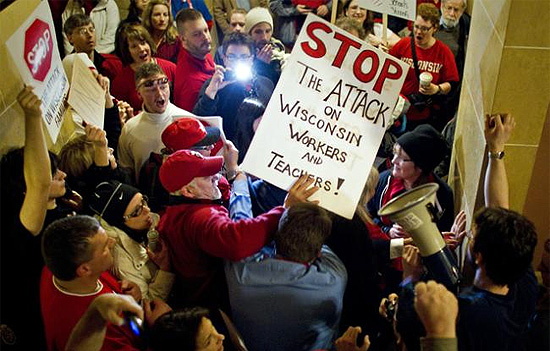
There's a huge throw-down in Wisconsin lately. As I once called this arctic wasteland my home, I try to check in every now and then and see if violent uprisings have taken over the land (my beautiful fiancĂ©e lives there, so these things are important). Well, it turns out that something like that happened just this week.

Wisconsin, like every other state, is running out of money. Thus, the governer, Scott Walker, decided to change (among other things), the health care and pension package for state employees. As per the war-time reporter at WTMJ:
Walker's plan would make workers pay half the costs of their pensions and at least 12.6 percent of their health care premiums. State employees' costs would go up by an average of 8 percent. The changes would save the state $30 million by June 30 and $300 million over the next two years to address a $3.6 billion budget shortfall.
Unions could still represent workers, but could not seek pay increases above the Consumer Price Index unless approved by a public referendum. Unions also could not force employees to pay dues and would have to hold annual votes to stay organized. Local police, firefighters and state troopers would retain their collective bargaining rights.
So, the pensions and premiums will increase, and they can't ask to increase wages above inflation. The last part seems sensable, but surely the premium increases are outrageous, right? Not really.
"It's not asking a lot, it's still about half of what private sector pensions do and health care packages do. So he's [the Governor is] basically saying, I want you public workers to pay half of what our private sector counterparts and he's getting riots."
So it all boils down to a privileged special interest whining because they'll have to pay half the rate for health insurance as normal people. A travesty, to be sure. *Yawn*, wake me up when they decide to refill the snack machine only one a month.

The best part are the demonstrations by the teachers union. Throwing the teacher unions out in from of the cameras is like threatening to drown a box of kittens. The image of a bunch of middle-aged women tending for sweet children evokes a mother-child image. Why, don't cut our pay, think of the children! If they cared about the children, they wouldn't work so hard to defend a system that pretty much does the opposite of educate. Those school teachers protesting at the capital are essentially like the autoworkers who made the Ford Festiva acting all hot and bothered about their pay when they make a product nobody wants to buy. Anyways, they look cute on camera and they get people thinking about the children, not the whiny antics of the other state unions.

But it doesn't stop there! For the price of one, you get two crazy events! While the republicans have enough votes to pass the bill, they legally can't even vote on it unless at least one democrat is present, and they all fled the state. Walker has be threatening to use the national guard to hunt them down and drag them back from their little stunt.

Wisconsin, you always make me laugh...

United Together for Unfair Wages


Labor unions serve no beneficial social purpose today. They were initially founded almost a century ago to battle low wages and poor working conditions. The reason that these are not big issues today has nothing to do with unions, and everything to do with more jobs to pick from. As long as you’re not working at a sweatshop with armed guards, you’re always free to quit. That’s not to say there won’t be costs involved, but if you ever find yourself in a Upton Sinclare-esque situation where you work 12 hours a day under life-threatening conditions and your boss rapes your wife while you’re gone, you don’t need to start a Marxist revolt to change.
The fact is that unions are nothing but a special interest now, and a huge industry as well. Through dues, unions rake in millions of dollars a year, and for what? As much as they may talk about it, the last thing unions want are fair wages. They exist to leverage huge amounts of power (including truly massive political donations) to insure that their members receive more wages and benefits then they could ever receive by negotiating in an open market.
The best way we can know the true value of something is by seeing what the market will pay for it. This is how we figure out the wages of everyone from butchers, checkout clerks, to football players. Yet, somehow we decided the government has to decide the worth of teachers and plumbers.  
It's not heartless to ask union workers to compete for wages like everyone else: it's common sense. If the wages remain too low to satisfy the workers, then they should change jobs. Steel workers in America have been suffering for a long time because American steel is manufactured more inefficient then and costs more then other steel. This should be a sign that our resources (either labor or otherwise) would be more efficient in another sector. These sectoral shifts are common and happen every few decades. To prop them up would be as foolish as subsidizing the failing buggy whip industry so it can compete against Ford and his new contraptions.  When unions press for more and more, the only result is a drain away from more productive sectors of the economy. 

Oct 18, 2010

Forging Truth

A colleague of mine recently wrote the following:

To me, liberty is not simply a political philosophy. It is my earnest attempt to bring people out of darkness, intellectually and spiritually. My advocacy of liberty is a call to the masses to reject all tyranny over the minds of men. This philosophy transcends questions of the scope of government. It is a cultural revolution, a rejection of ill-conceived prejudices and worn-out, anachronistic traditions that encourage ignorant conventions. This is a vision of a society far different from the one in which we share in today: one that operates on the premises of cooperation, tolerance, and rationality.

This surmises most of what makes me queasy with a portion of the libertarian movement. While we both reach the same conclusion, we do so through different means. Instead of being a question of efficient or even contented living, individual freedom becomes a means to “bring yourself out of the darkness, intellectually and spiritually”.

My biggest reason to opposing centralized force and control is because I don’t trust people. We all have darkness inside, a result from our fallen natures. The more power a given individual has over others, the more likely that they’ll do evil things to others. To borrow from C. S. Lewis, people who get into power tend to act like school-yard bullies. Even if they have the best intentions, they’re likely to a lot of harm before they’re done.

 Instead, others support economic and political freedom because it places the individual at the center of the epistemological universe. Man becomes an end to himself, and he’s set out to search for what those ends are. Subjectivity and post-modern “tolerance” reign.

The worshipers of the self would instantly object to me referring to a fallen nature. A priestess of this alter, Ayn Rand, took especial offence at the concept of original sin, calling it an affront to justice, and a removal of the will. She cannot stand the idea that evil might be in our natures and against our ability to change. This reveals a fundamental difference between Objectivism (and related philosophies) and Christianity.

The “spirituality” of individual freedom is a far cry from true spiritual freedom. To liberate oneself from reality is no liberation, but enslavement.  Spiritual freedom is not to create a god that best suits you, but to realize who God really is. Yet, this is not something we can do ourselves. There’s very little we can learn of God simply by watching sunsets. Instead, He must reveal himself to us. We’ll never hear His quiet, undemanding voice as long as we continue to place ourselves, our voices, first. A self-driven spirituality will ignore God as He is, and instead craft a false imagining serving us.  

Sep 9, 2010

The Freedom of Summer Afternoons

The campus becomes eerily empty every afternoon as classes wind down and students return to their concrete caves to recuperate and work on tomorrow’s hangover. The Reserve Officer Training Corp takes advantage of this and every Tuesday and Thursday they stand in neat little rows out in academic circle. They don grim faces and march behind their flags while a young man pretending to be R. Lee Ermey barks orders.

I ride my bike faster, now that the weight of classes has fallen from my shoulders. The approaching weekend shines past Friday’s remaining classes; they might as well not exist. Rock music in my ears, sun on my skin, and wind clutching at my clothes are the principle components of that exhilarating sensation known as freedom. But seeing those prospective soldier standing in formation with their cute matching uniforms makes me feel freer then a Friday afternoon ever could.

No, this isn’t some misguided sense of patriotic freedom, where the reverberations of ancient globe-spanning conflicts are used to color modern aggressions. It’s the feeling I get when I realize I can choose which clothes to wear, where I get to be at 1500 hours Tuesdays and Thursdays, and most importantly, what I spend my life doing after I graduate.

I can hear the angry dissent right now. Do not these brave students sacrifice themselves to protect my freedom to be young and disrespectful? I don’t hate freedom; I just don’t think we need so many guns and spies to have it. If I felt more threatened by a foreign power then the domestic one, it might be a different story. Perhaps I’ll write a well-researched essay on why militaries inevitably threaten freedom, compete with quotes from famous people everyone respects, but Working Man just started playing on my iPod, and there’s only a few more hours of sunlight left to enjoy. Hey, somebody has to have fun!

Aug 23, 2010

Feeding Time and Your Rights

SF Weekly has a story about a lawyer who's found a particularly sweet honeypot: suing resurants with poor disabled access. He's been making bank finding people who pretend to be hurt because they couldn't eat where they wanted to.


Mr Frankovich has already been blasted for abusing the spirit of the Americans with Disability law, but lets pretend for a moment that it doesn't exist. Imagine I own a greasy spoon called The Carotid Artery. Only a single-wide door allows entrance into my cholesterol paradise, disallowing the most obese of customers. Lured by the smell of fresh meat, they gather around my door and try to wedge their lumbering masses into my humble cafe, but to no avail. Mr. Frankovich, liberator of the oppressed, will you have mercy on me?
Frankovich says he has no patience for the "mom-and-pop crap" as an excuse to not be complaint with ADA requirements that have been in effect since 1990. "Quit your crying and wimping and I'm a minority, because they are picking on the most deprived of minorities." 
Apparently not. I forgot the principle right of being able to do anything you what, wherever you want. 


Perhaps I'm being a bit harsh, as he's talking about people in wheelchairs, not the obese. While people never choose to be wheelchair bound, I know that nobody has any duty to serve them, disabled or not. However, money talks. McDonalds will never turn me down while I have cold cash in my hand (with shirt and shoes), mostly because McDonalds likes money. They serve nasty "meat" products because I'll give them money for it. Yet if a ritzy jazz club that serves rich seniors wants to toss me out (and they will), that's their right.


Perhaps Mr. Frankovich ought to talk to this man:


Aug 13, 2010

The Westboro Anarchists

Ultimately my experience with IHS this summer has more akin to a class with a really difficult professor. Not that the lectures weren’t relevant and informative, or the internship itself wasn’t educational, for they were. Instead, I’m referring to the clash of ideas with the other fellows that (for us state-based interns) occurred primarily during the opening and closing seminars. While a respectful debate between peers produces understanding, learning to deal with hostile conflict 

We all believed in limited government and free markets, but a vocal segment decided that that wasn’t enough. Instead of creating allies, we drew lines. The label “statist” was bandied about with extreme prejudice, even though none of us could remotely be considered fans of the government.

One understanding I have of Anarchy involves an entirely voluntaristic state populated by entrepreneurs who live together in peace and harmony because they have grown past the need for force and violence. It is, in a hippy-sense, loving. Yet I saw nothing loving from its more serious proponents.

I know it’s inappropriate to judge an entire movement based on a few individuals with egos like bloated, puss-filled welts, and thus I have dubbed these people “The Westboro Anarchists”. On some level it might be better to even take their sect status away and simply relegate them to the loony bin.

The oddest part was I received more hostility from the Westboro Anarchists then I have from people who hate capitalism. It was almost because I was ideologically close to them that fueled their raged. Were I a modern liberal who idealized Che Guevara, they might view me as a three-legged puppy: and object of pity with an intellect too small to comprehend their brilliant arguments. However, because I “compromise” by only working within the realm of political and cultural reality, I have been tainted and must be purged. Anything less then utopia is heretical. Burn the alien, the mutant, the statist.

It reminds me the story about how Mises refused to talk to Hayek for a decade because he suggested that public education might be a public good. Crime of the century.

There must be some reason inherent in the thought process of some radical idealogs that causes these barbaric mutations. Is it the feeling of being an elite in possession of the gnosis? Perhaps it’s a smug superiority that believes that the thoughts of others ought to bow before your sandal-clad feet? Whatever the reason, they better enjoy their own little world, because sycophants aside, they will gain no followers.

Yes, they were out of bounds. Yes, they were anything but respectful. But that’s how the real world works. Deformed foes who fill their bloated stomachs with the torn flesh of allies prowl the alleys of though, and it is good to be ready for them. At the very least, the revulsion will be less.

And let it be known that I do find the anarchist theories to be engaging and profitable for discussion. I know that it can be respectfully discussed and debated. Instead, I fight mostly against buffoons, regardless of ideology. 

Aug 8, 2010

Realistic Solutions

I suppose that would be too simple, eh?

From SMBC

Aug 5, 2010

I Feel So Much Safer

It's something that seems pretty simple, but like most simple things, it's likely be illegal. Intel has been giving discounts to computer manufacturers if they promise to purchase only Intel chips. Two companies voluntarily making a deal between themselves, an act that is obviously monopolistic and illegal. At least that's what the Federal Anti-Trade Commission said today.

Blame Fish–Lips
Honestly, does the FTC even know what a monopoly is? Just for clarification, a monopoly is "A company or group having exclusive control over a commercial activity." An 80% market share is not a monopoly. AMD may be throwing a fit because they're losing to their competitor, but they are still selling chips. If there's an alternative manufacturer, Intel does not have exclusive control. 'Just saying.


Thank you, FTC, for getting all up in everyone's business. Intel makes good chips, so people start buying a lot of Intel chips. This is not anti-competitive "market dominance". If there is a market, you cannot be anti-competitive. There's always the chance that the next line of intel chips blows chucks and the AMD ones don't. Do you really exercice dominance and control over a market when you still are subject to your customers? 


For comparison, a true monopoly is where there is only one seller and it's impossible (or more likely, illegal) for anyone else to sell but you. Because of how difficult this is, it really only exists when the government shoves it's slimy hands down the pants of the market. But even if a company DOES manage to capture 100% of a market, they still can't act like a monopoly. 


Say for example that John's Inc. makes all the buggy whips in the world. They feel powerful and thus charge twice as much as before. Chances are good that someone else will start making buggy whips for less, competing the price down. Did John's Inc. have a monopoly? Nope! But even if that doesn't happen, what happens when Ford Inc. shows up and starts making cars? John's Inc. goes under even if he doesn't have competitors! John's Inc. never controlled the market, as he was still wholly subject to the whims of the people.


With Intel, we have both a rapidly changing market AND competitors. There's nothing more competitive then the technology market. Someone should get the FTC some coloring books, as they obviously have too much time on their hands.

Aug 3, 2010

U-Stor-It: Stimulus Style

Recently, the stimulus packaged dropped like a huge steak into the pit of slathering dogs that is North Carolina. Like a Six billion dollar steak, to be exact. When a legislative body gets a huge sack of money with the only instructions being "spend it", crazy stuff happens. 

One of my favorite wastes of money happens to be turning old shipping containers into low-income housing units. Yes that's right, just like in Snow Crash. I'm sure there's nothing more poor people want then to live in then small metal boxes built with government money. Well, I'm sure there's a lot of things people stuck with the label "poor" want. Thankfully, because of the high level of income mobility we have, people rarely stay in the "government metal box" category too long.

How long until these become mold-infested and abandoned, only to be squatted in by people like Hiro and Vitaly? 

Next time a round of stimulus comes around, I'm holding a contest for the craziest thing that it gets spent on. I'm only half-joking about setting up a random government project generator and seeing how many it gets right. You might be surprised. Then again, you might not, cynical folks that you are.


Aug 2, 2010

Cuba: Keep on Truckin'

More evidence about the failure of Communism today: In the face of economic crisis, Cuba starts to lessen its stranglehold on the economy. Raul Castro plans to "update the Cuban economic model", but not because it's proven to be a horrible failure and it has lead to the suffering of hundreds of thousands of human lives, but because they just want to be cool.

"With experience accumulated in more than 55 years of revolutionary struggle, it doesn't seem like we're doing too badly, nor that desperation or frustration have been our companions along the way," the president said.
A happy citizen enjoy his healthcare

 No, no, you're doing fine Cuba, just peachy! We could all do a little better, we understand. It's hard to run a whole country by yourself, especially since your older brother pulled a Bin Laden and has not been seen since becoming terminally ill four years ago. Are the Fearless Leaders of Cuba above mortality, or am I confusing you with Best Korea? I confuse all you Utopian states.

Oh, and that health care system? World class.

Remember that scene in The Godfather Part II when they go to Cuba? Remember the spender and wealth that surrounded them? Yeah, it's still like that. EXACTLY like that, covered under 60 years of decay and poverty. It's like a post-apocalyptic fantasy where the constructs of yesterday crumble under the to stave off death for just one more day. And you know how much I love post-apocalyptic fantasies!

You know what Cuba needs? Zombies roaming the streets of Havana, seeking human flesh to devour. Maybe that's the only thing that us wealthy Americans can use that at all approximates living in a communist nation. Remember: your chances of surviving a zombie attack are NEVER as good as you expect them to be!

Perhaps I'm making too much light out of a very serious situation which is beyond cruel and evil. But it's mind-blowing that people don't see the horrors of communism, after a century of examples.

Jul 28, 2010

The New Imperial Cult

The President of the United States bears the ever-increasing weight of responsibility, a weight that only grows only more massive as time rolls on. Now, more than ever, we place our demands and desires before the door of the oval office.

Obama’s intercessions in the Gulf oil-spill were only necessary because the people clamored for action. While we already have a legal system in place to deal with liability, Obama strong-armed BP into creating an alternative one, not primarily because it would be better, but because we demand action.

From the bank bailouts to the economic stimulus package, we have demonstrated that we prefer actions to results. We demand our country be like a Michael Bay movie; flash and explosions without purpose or motivation. We don’t care what happens, as long as it does, and fast. We beg for a figure with the splendor of a modern celebrity and the power of an ancient deity. In other times, we would have constructed a temple; today we’ll just give him a star in Hollywood.

With the possible exception of the Civil War, there have never been more crises then when America was founded. Shoe-horned onto a continent surrounded by entrenched empires on one side and hostile natives on the other, the leaders at the time had far more to be concerned about then we today every have. Yet, instead of pounding a bully pulpit and demanding more authority, they deliberately limited it.

This worship hardly started with Obama, but he wears it best. We have come a long way from the unassuming chief magistrate the framers had in mind. Today, voters are whipped into frenzy, one mock crisis at a time. Bill Clinton exemplified this when he said “we must also protect our children by standing firm in our determination to ban the advertising and marketing of cigarettes that endanger their lives”. Thankfully, the dire consequences of cigarette advertising have been narrowly averted, and society was made safe again.

We ask for jobs, but all we get is inflation. We ask for protection, eventually, we realize that the president is not a deity. Instead of realizing our blasphemy, we decide that we simply chose the wrong one, and start our search for god-king anew. Our latest pick has described his ascension as the moment the “oceans began to slow and our planet began to heal”.

George Washington might have rejected kingship, but today we’ll elect no man who is not willing to wear the crown.

F2P and Price Discrimination

Massively multiplayer online games (mmo's) have always had a different business model then most games. Instead of a one-time purchase, mmo's have subscription fees to help pay for on-going development and server fees.

Those $15 a month subscription fees add up quick. Playing a typical mmo steadily for just a single year totals $180 (not counting the price to buy the game in the first place). While this sounds ridiculously expensive, it might be cheaper then purchasing new games throughout the year. Now you can see why publishers slather their lustful lips over creating a top-shelf mmo: it's a licence to print money.

...As long you're popular. MMO's have a chicken and egg problem: players flock to games with a sizable population of players. Nobody wants to log on and find an empty world with no other players. 

A great example of this was Warhammer Online. Despite being a well-crafted game, they over-estimated the number of players, and set up too many servers. Lower server populations meant that players had a hard time finding others to group with, and many left. WAR will likely flounder around for another year or two before collapsing. Maintaining a player population can mean life or death for a game.

To boost populations, many games are switching to a free-to-play model (f2p). Accounts are free to create and play without a subscription. Instead, players pay to unlock parts of the game: certain races, classes and quest areas. While free-to-play is a deceptive title, it does allow for the player to control how much they wish to play for the game. This acts as a price discrimination for players that might not wish to feel they play $15-worth of game a month. Many games that are having problems keeping their population levels are shifting to this new scheme.


The community often views going f2p as admitting failure, while in reality this is branching out to a different audience. We're watching the market innovate right before our eyes here!