My aunt lives on a farm in the middle of the Wisconsin countryside. Like Keepers of the Citadel, innumerable cats run around, performing secret but essential tasks. As needed as they are, no one’s taken care of them in years. Once you could wonder into a barn and be greeted by a furry tribe of cuteness, but now you find a swarm of hideously inbred monsters. Adventure games are like those cats. Leave them alone in a vacuum for a decade and what comes out is a sickening mixture of all the recessive genes of 1990s point-and-clicks. Yet, where there’s a will, there’s a market. Some studios actually manage to craft fun games out of inventory puzzles. Adventure vets Pendulo think they can straddle the line with Yesterday and still deliver an approachable yet hardcore classic adventure game. Wrapped up with the styling of a horror thriller, is Yesterday a cute and cuddly kitten, or a mangled, inbred beast?
Showing posts with label games. Show all posts
Showing posts with label games. Show all posts
Mar 28, 2012
Review: Yesterday
My review of the recent adventure game Yesterday is up on The Adrenaline Vault. It's telling that a terrible game can still be a pretty good example of the genre.


Mar 27, 2012
Myth Retrospective
The Adrenaline Vault has posted my retrospective article on the Myth series. It was New-Wave fantasy and had a narrative that was enhanced by the gameplay, not just featured along side it.
It’s understandable that Bungie would want to leave the Halo business. Once upon a time, they developed a host of different games. Around the new millennium, a bright-eyed stranger with deep pockets arrived and offered a deal they couldn’t refuse. By June of 2000, Bungie moved into the Microsoft harem, leaving behind all their children except their latest and most promising one, little baby Halo. Among those left behind were the Myth twins, two real-time tactics games known as The Fallen Lords and Soulblighter. Oppressively dark and punishingly difficult, Myth was an ancient burial ground of narrative. The bleached bones of fallen empires and the rusted armor of deadly warriors lay half-buried, whispering warnings to the players that they’ve never played something like this before. Nor have they ever since.

Jun 15, 2011
Not Just a Game: Historical Conflicts and Fun

While Stone talks about deep wargames that typically involve large hex-maps scattered with tiny counters and cardboard squares scribbled with arcane abbreviations, his point also applies to the very-popular First Person Shooter. These multi-million dollar productions push the graphical capabilities of their platforms to make loud manshoots geared towards the American male. Today they are little more then Hollywood-style action games set in fictional conficts, and contain about as much depth as schlock like Battle for LA, but it wasn't always this way.
For many years, games such as Metal of Honor: Allied Assault gave a (for the time) unique and visceral look at World War II. As a kid, I remember playing MOHAA and being flooded with sadness when the words “Pvt. Kelly has been killed” appeared, telling me that one of the friendly AI soldiers had died. They have names? I thought to myself. Suddenly, the game became less action-shoot-em-up and more meaningful. It let the player get in the helmet of a solder for a while and role-play someone more then John Rambo.
After its success, most of the lead developers of MOHAA left and formed a new company, Infinity Ward. Their first production blew their previous work out of the water. Call of Duty went out of its way to make the player feel like they were surrounded by the battlefield. Many more allies at your side, planes swooping overhead, and gunfire crackling in the distance greatly improved what MOHAA tried to do years before. Lots of work went into make the player feel like only a small part of a much larger conflict. It deepened that role-play experience and made this historic war very real and moving to the player.
COD used this graphical fidelity for more then just a flashy action game, it actively used the game mechanics to make these historical events meaningful. Towards the end of the game, the perspective switches to that of a young Russian man just pressed into service at the battle of Stalingrad. You are pushed through a line to get your equipment, but they hand out a gun to one man and a clip of ammo to the next. Supplies were low, but bodies were plentiful. The Russian strategy was literally to throw civilians in front of machine guns until their barrels melted or they couldn’t shoot over the pile of corpses. Soviet officers with sub-machine guns stood back, ready to shoot anyone who took a single step backwards. So, when the player goes from being a heavily armed Marine to a poor soviet draftee, it added a whole new level of depth to what would otherwise be a dumb action game. It made the bloodiest battle of the war seem very real and moving. I felt like I actually learned something about WWII on a deep emotional level.
Years later, as the COD franchise would become the billion-dollar monster that it is today, the tones would shift. Call of Duty: World at War tried to revisit WWII but without any of the respect that it’s predecessor had. Shocking torture scenes, ridiculous gore and a soundtrack bristling with metal guitars turned war into action movie for frat boys. Marines mowed down enemies while screaming typical xenophobic slurs and all but chest-bumping each other. The soviets soldiers, once pitied, now became anger-filled monsters themselves. CODWAW was a game that didn’t fear the horrors of war, it relished in them, the bonus missions at the end with hoards of Nazi Zombies told that much.

COD continues to be the biggest seller in the gaming world. Even if its mechanics are pretty fun (and over-rated), it’s a game about war that ignores the largest, most deadly important point of war: it’s hell and nobody really wins in the end. That is why it offends me so.
Even though I’m against war as a tool of foreign policy in general, I still respect those that suffer though it, as needless as it is. I'm not against it's depiction (sometimes it's critical), but it's the portrayal that matters the most. It's the difference between the typical John Wayne action movie, with war depicted as a heroic endever that's almost fun, and Saving Private Ryan, which depicts war as a heroic endeavor that's anything but.
Even though I’m against war as a tool of foreign policy in general, I still respect those that suffer though it, as needless as it is. I'm not against it's depiction (sometimes it's critical), but it's the portrayal that matters the most. It's the difference between the typical John Wayne action movie, with war depicted as a heroic endever that's almost fun, and Saving Private Ryan, which depicts war as a heroic endeavor that's anything but.

Jan 31, 2011
The Big Picture: Narrative Focus

Once upon a time, Call of Duty was a powerful experience for players. What distinguished it from other games was it's narrative focus; instead of being a one-man army that was responsible for single-handedly winning the war, the player felt like a small part of a much bigger conflict. The WWII setting didn't have to be explained much. All the player had to know was that if those AA batteries weren't taken down soon, a bombing run would fail. Not that the war would ever actually be lost, mind you (players would just have to try it again before getting it right), it convincingly built up the right tension to make the player feel in the middle of something bigger.
The WWII setting provided more then just a historical backdrop; provided a large, wide-ranging conflict that doesn't need to be explained. The motivation of the Nazi's doesn't need to be explained, nor do those of the player character. The game can show some German soldiers shooting civilians or something to emphasize the point, but the player already knows who are the bad guys and why they must be fought.
A couple sequels later, the setting changes from WWII to something more modern. Instead of being set in Iraq or Afghanistan, the conflicts are entirely fictional. More importantly, they are based around characters: heroes and villains. This provides for a fundamentally different narrative then the previous games.
Massive, globe-spanning conflicts that focus primarily on a handful of heroes and villains is something that mainly works in fantasy. We never question the central rolls of Gandolf, Sauron, and Frodo in the war for the ring, because everything in their world is aggrandized. It's entirely plausible. When that same tactic is applied to our world, we begin to question the plausibility of the situation. A story about a single man turning back the tides in WWII and winning the war (by assassinating Hitler in a slow-motion shoot out) would be pure, ridiculous cheese, yet that's essentially what has happened.
The real world is far to complex to be changed by any one person.
Nov 16, 2010
Good Game, Wretched Plot: Why Modern Warfare 2 Is More Terrible Then You Think
The Call of Duty franchise is so popular that reports of it’s record-breaking sales receive spots on the nightly news. It’s unique blend of adolescent gun-fetish and accessible gameplay practically print money for Activision-Blizzard. While players spend most of their time online in multiplayer battles, Call of Duty pioneered the idea of a heavily-scripted single-player campaign that pulls every thematic punch it can to create a cinematic roller coaster ride.
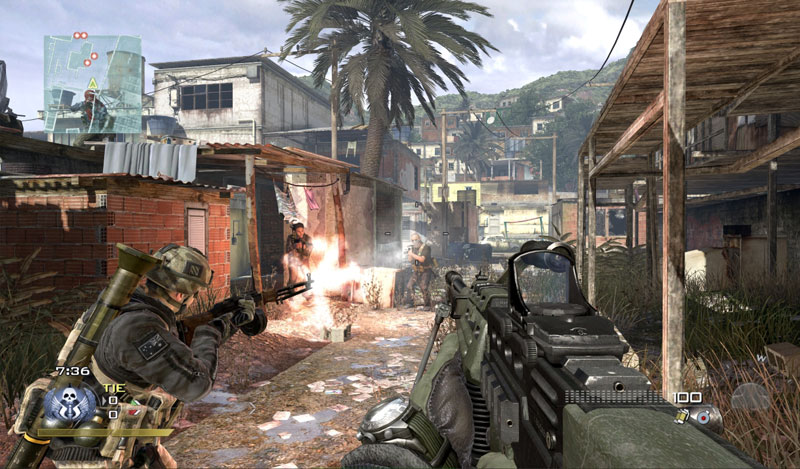 The story to the fifth installment of Call of Duty (confusingly called Modern Warfare 2) amounts to little more then a cold-war era wet-dream. The first game had you swatting down a Russian extremist who had it out for the west (because, I don’t, he didn’t like Kanye West or something). His followers now are out to avenge his death in the sequel, and they do it by framing an airport massacre (committed by them) on Uncle Sam. The next scene is a squad of marines fighting house-by-house in a DC suburb as Russian paratroopers rain down from the sky against a flame-red backdrop. Toss in a US general who allows the entire thing to happen because he didn’t win hard enough the first time around, and you have Modern Warfare 2. It only makes a little bit more sense then Axecop.
 The game is viscerally gripping only because it instantly recalls 9/11. The plot mirrors the real-world, even if in reverse, where Russia invades ‘merica for a perceived terrorist attack. This could have been used for a thoughtful introspective into the patriotic attitudes surrounding the Afghanistan invasion, but that would be far too much weight for this GI-Joe plot to handle. Instead, we get a bunch of heroic meat-heads pulling every action movie clique in the book. While the battles are breath-taking, they would be better played out of context, lest the seams (where narrative should be) show.
Call of Duty was the more innovative successor to Medal of Honor, essentially the video-game equivelent of Saving Private Ryan. It sudden made these historical events real. Black-and-white History Channel shows became relatable. Players will be hardpressed to forget that first level as a soviet conscript, pressed into service at Stalingrad with out a rifle. It showed the power of the interactive medium to convey meaning and respect, but the latest installment makes war into a childish Schwarzenegger flick. So much for respect.
Worse, there’s nothing modern about Modern Warfare 2. It’s so chocked-full of all-powerful super-tech that it might as well be a sci-fi game. It looks like a Popular Science cover story. Even current weaponry, such as the Striker infantry support vehicle, are worshiped as modern-day titans roaming the earth. The loading screens are mock-computer displays, showing wireframe diagrams and statistics in true Hollywood fashion. Is it meaningfully useful? No. Is it impressive if you don’t know anything about how the real world works? Yes. It’s the same thinking behind the army’s new ads, making service out to be a sci-fi video game. MW2’s writers spend so much time trying to impress the player with their magic-tech that they even show you what it’s like when it’s removed by an EMP blast from a nuclear explosion in above DC. Subtly is not among their strengths.
 |
| Yes, that is the Washington Monument |
The situation wouldn’t be so bad if the Call of Duty franchise wasn’t a symbol for gaming as a whole. Instead of a proper representation of the strengths of the medium, the public sees bad Tom Clancy fanfic. What if Braid made it to the nightly news instead?
Sep 13, 2010
Silent Films and 8-Bit Games: Limitations and Art
While they once created empires, silent films lay still today. Few people ever dive back in time to experience cinemagraphic life before sound and color, and certainly nobody makes them any more. If one played at the local movie theater, the only people who would show up would be the few resident film junkies and the stoner who stumbled into the wrong movie.
 Curious, I watched the original Mark of Zorro the other day, and was surprised. I’d expect something that old to be unapproachable, with a slow plot and boring and uninteresting cinematography. Plot-wise, it was something that we might see today. Zorro might well be a 17th century batman, saving damsels at night, and generally being socially awkward during the day. Even the stunts were impressive, doubly so when you realize they had very little special effect trickery.
What fascinated me was how few tools the filmmakers had to tell their story. Scenes of dialog were slides of sparse exposition followed by silent acting. Most of the time you had to guess what was being said. Oh, look, she’s getting angry! I guess he said something bad. Now the scene’s colored in monochromic blue, I guess it’s night!

The limitations that silent movie makers dealt with are strikingly similar to those video game makers had in the 80’s to early 90’s. Limited graphical capabilities required the player to use their imagination. Modern hardware allows game designers to paint their world using art styles as diverse as photo-realism, cell-shading, or even art-deco. Back when pixels where large enough to be counted by hand and only a handful of basic colors could be used a once, luxuries like “art styles” did not exist.
The limitations of both silent films and 8-bit video games leave a bit of the world up to the viewer. The portion that the imagination makes will always be more vibrant then any prepackaged notion. This idea summarizes the appeal of books, as well. While everyone can enjoy a Hollywood thrill ride, or $100 million dollar AAA video game, they can never truly rival a medium which lets the subject in on the creating.
Subscribe to:
Posts (Atom)