I grew up on Star Trek. We watched TNG as a family every week as a kid (but I only remember the scary episodes). I had action figures for every crew member and a toy shuttle to fly them around in. My model enterprise regularly battled the dreaded borg cube. When Voyager debuted, we followed it as well, but only for a season or two. My parents didn't like the characters as much, nor did they appreciate the preachy left-wing politics. While I've gone back and watched TNG as an adult, Voyager has remained a cultural blank-spot for me until now. I've swallowed all the resentment that I've harbored towards Janeway's intrepid crew and started watching the series again, from the beginning. These are my notes:
 The crew fits the standard Star Trek stereotypes: the funny one, the serious one, the agressive one, the empathic one. The Doctor is by far the best, perhaps the best in any Trek. He's sarcastic and witty. He fills the role that Data started, but he doesn't feel rehashed. Paris is fun because he's essentially Tom Sawyer in a uniform. Kes follows the standard other-worldly/creepy/empathic type. She also might be the only female on board. I don't know who Harry Kim is, I'm not sure he actually HAS a character yet.
 As far as Janeway is concerned, I'm trying to like her, but sometimes she feels like a space Hillary Clinton: progressive, strong and compassionate. So far, she's the standard Trek mix of diplomacy, force, and intellectual learning (her knowledge of astrophysics seems a bit tacked-on). Sometimes I miss Picard's commanding presence. Is it sexist that I prefer a strong, male leader to a similar, female leader? Perhaps it's just hard to compare anyone against the great Patrick Stewart.
For being across the galaxy, the aliens aren't really alien at all. It's a classic Trek troupe that the aliens either are normal humans with funny ears and foreheads, or the occasional man in a suit. When back home in the alpha quadrant, it's at least slightly plausable that the various races have similar characteristics. Yet, in the Delta quadrant, we find civilizations that look exactly like those on Earth (and even speak english!). I suppose this isn't a knock against Voyager, but against Trek in general. It makes the show less science fantasy and more science fantasy.
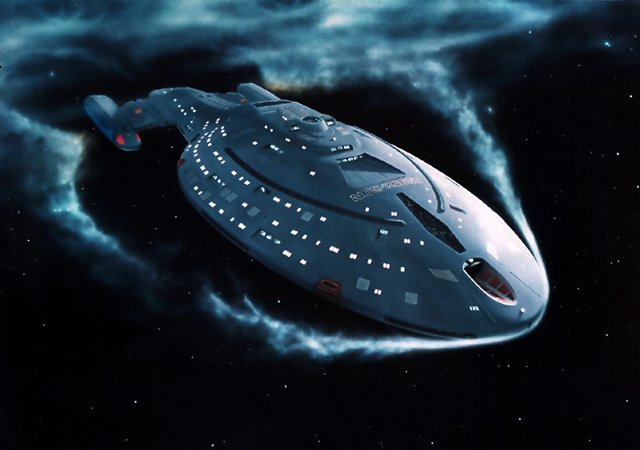 |
| Great Intro! |
I understand that Star Trek isn't supposed to be dark, but that doesn't mean it can't be adult. It's hard to swallow a story of this magnitude when it's coated in sugar. In comparison, the new Battlestar Galactica features a similar theme of survival, and amid all the darkness, most episodes (in the first few seasons) ended with a silver lining. The feelings of helplessness and dispare as the remaining humans flee from the Cylons gave depth and meaning to every victory they win. Without something heavy to contrast it with, the tragedy of the Voyager isn't much different from a child having an imaginary adventure in his back yard. Things might get difficult and scary, but the child will always defeat his fantastic foes and come back in time for supper.
When I started to make a list of things I would change, I realized how many of them apply to Trek as a whole. What started as a quirk in one series has become ingrained into the very fabric of the franchise. As great as Trek is, relying on the same tired troupes really holds it back.
When I started to make a list of things I would change, I realized how many of them apply to Trek as a whole. What started as a quirk in one series has become ingrained into the very fabric of the franchise. As great as Trek is, relying on the same tired troupes really holds it back.
Having only watched half of the first season, this all might seem very preleminary. I hope I am wrong about many of these things, because so far it's a good Trek with interesting plots and great production values.


No comments:
Post a Comment