
I’ll be discussing quite a few plot points in this review,
so expect spoilers. These books are classics, so you should be reading them
anyways. My short advice is to read Ender's Game without hesitation, but pause before reaching Xenocide.
Ender’s Game:
Ender’s Game is a classic for a very good reason. I also
think that its subject matter had a lot to do with its popularity in geek
circles. The way that Card gets into the minds of super-gifted kids delights
those of us who lived with the gifted label. Sure, they might talk like adults,
but that’s the point he’s making. When you take a child away from normal life
and drill him into a creepy child soldier, he’s going to be pretty haggard,
whether or not you think it’s for a good cause. Card does an outstanding job
making you think about the events from moral perspectives.
Ender takes the classic alien invasion story, mixes it up
with dual shots of philosophy and physics, and then turns it on its head. It’s
not only a fantastic stand-alone novel, it also serves as a solid launch pad
for a much larger story. Not too much to say about it besides you’re crazed if
you don’t read it, nerd or not.
Speaker of the Dead:
When I first read Ender a year ago, I was a bit apprehensive
to continue the series. I heard that the other books were very different, and I
wondered how they could ever top this one. I figured they were just the
author’s attempt to milk a popular series. I was quite wrong, and I wish I had read them
sooner.
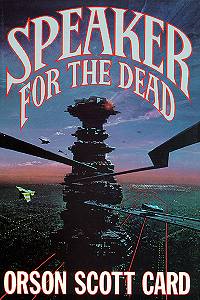 While Ender’s Game was content to focus on one person’s
development, Speaker throws the doors wide open. A dozen Ender’s Games are in
Speaker, plot-wise, and each thread is just as taught. Speaker not only works
so well with Ender, but it adds so much depth as well.
While Ender’s Game was content to focus on one person’s
development, Speaker throws the doors wide open. A dozen Ender’s Games are in
Speaker, plot-wise, and each thread is just as taught. Speaker not only works
so well with Ender, but it adds so much depth as well.
Speaker was the book Card originally had in mind when he
wrote Ender. Instead of simply picking up from where Ender left off, it leaps
three millennia into the future. On one
hand, I was hesitant to leave the familiar world of Ender behind, but the new
wonders awaiting me in Speaker coaxed me out of my shell.
Card writes characters very well, so the increased cast size
works. Andrew works his way into the family drama, telling them
what they need, not what they want. This entire plot-thread echoed so very much
of a personal Christ that I looked up the author to confirm whether or not he
was a Christian. Like Jonathan Strange and Mr. Norrel, Speaker shows that it's possible to write Christian stories without devolving into the starchy pulp that gets sold in most religious bookstores.
The mysteries do a good job of holding the plot together.
Why did Novinha marry a brute of a man instead of the one she loved? Why did
the Piggies murder two xenologers? Why does the ecology of Lusitania feature
such a sparse biological landscape? They drive the plot forward and keep
everything flowing at a good pace without seeming artificial or boring.
The mysteries resolve mostly satisfying. It was beautiful to
watch Card slowly unravel some of his delicately-wound characters so we can see
every stich and seam. The human mysteries are truly the best, while the
scientific mysteries are more flat. Perhaps this is only so because the human
stories are so rich by comparison. In retrospect, Speaker seems more about
people then about any larger sci-fi motif. Then again, perhaps this was also
true for Ender’s Game.
Besides personal drama, Speaker loves dealing with the
philosophy of aliens and intelligence. The categorizing of beings into levels
of familiarity and intelligence did a lot to facilitate the discussion of the
destruction of other species for self-preservation. It’s these discussions that
make it more then just family drama and sell the novel to the geek sci-fi
crowd. They’re some of the finest parts of the book by far.
However, the thread about the descolada virus is not quite
so good. The reveal at the end works
I suppose, but it seems far too weird for my tastes. I swallowed it regardless
and the rest of the story went down just as well.
At the end, many plot threads are left untied. I didn’t mind
it because the story was truly about Novinha and her family. These parts
resolve into satisfying conclusions, so I didn’t feel like I was taken for a
ride. Xenocide on the other hand….
Xenocide:
I dived into Xenocide right away, excited to see the larger
threats in Speaker resolve. So many juicy plot threads were left dangling to me
to resist the pull of the sequel for long. I spent half as much more time
slowly following their winding trails only to be left disappointed.
 The progression seems to flow naturally from Speaker at
first, but there’s a twist at the end that tangles everything into a nasty
knot. Xenocide first introduces the idea of Philons. If the full revelation of
the Descolada in Speaker was a bit off, Philons is full-on midichlorian weird.
If it sounds like an idea that belongs in a different series of books, it’s
because it was (but the publishers encouraged Card to merge them).
The progression seems to flow naturally from Speaker at
first, but there’s a twist at the end that tangles everything into a nasty
knot. Xenocide first introduces the idea of Philons. If the full revelation of
the Descolada in Speaker was a bit off, Philons is full-on midichlorian weird.
If it sounds like an idea that belongs in a different series of books, it’s
because it was (but the publishers encouraged Card to merge them).
The Philon idea then leads everything into a magical
dreamscape that recreates old characters from Ender’s Game and leaves you on
the promise that you get to watch them run free in the next book, Children of
the Mind. It felt unnatural and I cannot conceive of any way for the narrative
to resolve in a way that doesn’t feel fake.
I’m aware that it’s a bit awkward to end on Xenocide, when
by the authors admission, it and Children of the Mind were conceived as a
single book. I should likely finish the fourth book before making a judgment,
but I don’t care that much any more.
What started as bubbling excitement in Speaker ended in
disappointment in Xenocide. The big threats, such as the fleet destroying the
colony and the fate of the piggies have been teasing me for two whole books
without any satisfying conclusion. Someday I’ll finish what I’ve started and
perhaps learn that I was wrong again, but in the mean time, I have Steven
Erikson tickling every Post-Modern element of my brain right now. Another time,
Card. Perhaps another time.


1 comment:
I'm with you all the way with your thoughts on Ender and Speaker. I'll admit that Xenocide was my least favorite of the four books, but really...you have to give Children of the Mind a shot. It's very, very worth it. Children of the Mind was my very favorite book in the Ender series, and it's the best book by Card that I've read. Don't miss out!
Post a Comment