It’s understandable that Bungie would want to leave the Halo business. Once upon a time, they developed a host of different games. Around the new millennium, a bright-eyed stranger with deep pockets arrived and offered a deal they couldn’t refuse. By June of 2000, Bungie moved into the Microsoft harem, leaving behind all their children except their latest and most promising one, little baby Halo. Among those left behind were the Myth twins, two real-time tactics games known as The Fallen Lords and Soulblighter. Oppressively dark and punishingly difficult, Myth was an ancient burial ground of narrative. The bleached bones of fallen empires and the rusted armor of deadly warriors lay half-buried, whispering warnings to the players that they’ve never played something like this before. Nor have they ever since.
Mar 27, 2012
Myth Retrospective
The Adrenaline Vault has posted my retrospective article on the Myth series. It was New-Wave fantasy and had a narrative that was enhanced by the gameplay, not just featured along side it.


Feb 21, 2012
How Not To Write a Villain: The Horus Heresy
 Because the reader is (assumedly) approaching these books
with knowledge of Warhammer 40k, we know that Horus is going to be a bad guy.
We already know that everything going to go belly up and we’re just holding our
breaths as to when and how. Even so, the first impressions of the Warmaster are
positive. He’s shrewd, honorable, and full of more sense than we usually
ascribe to Space Marines. At one point, he decides not to murder a peaceful race of distantly-related humans, a rarity
in this xenophobic universe. After a while, we start to forget how twisted he’s
soon to become and actually like him.
This was how first book, Horus Rising
by Dan Abbnet ended.
Because the reader is (assumedly) approaching these books
with knowledge of Warhammer 40k, we know that Horus is going to be a bad guy.
We already know that everything going to go belly up and we’re just holding our
breaths as to when and how. Even so, the first impressions of the Warmaster are
positive. He’s shrewd, honorable, and full of more sense than we usually
ascribe to Space Marines. At one point, he decides not to murder a peaceful race of distantly-related humans, a rarity
in this xenophobic universe. After a while, we start to forget how twisted he’s
soon to become and actually like him.
This was how first book, Horus Rising
by Dan Abbnet ended.
After an amazing introduction, I had to dive right into the
second book. This is where everything has to get juicy, right? We see more of
the dark conspiracy dedicated to warping Horus, and the tension ramps up. At
the climax two-thirds of the way in, Horus is finally caught in the trap. Finally,
we get to see what can change this paragon into a monster, right? Instead, the
scene cuts away and next we see Horus, he’s an evil, bloodthirsty guy talking
about overthrowing the Emperor.
That’s right, instead
actually showing us what we waded through 1000 pages for, we get a quick edit
that explains nothing. I read Warhammer for the grand, bloody space operas, not
the literary depth. Even so, it’s an incredibly unsatisfying resolution. If you’re
going to go through the trouble to add a deep backstory to a villain, it’s a good idea to
include why he’s a villain in the first
place.
Feb 2, 2012
The Man With The Golden Gun: How Not To Write A Villain
 With my recent acquisition of an old, first-generation
Kindle, I realized that I could quickly and easily read just about anything I
wanted. After working through some truly great works, I started eating up all
the pulp that I’ve always wanted to try, but never got around to. The Man With
The Golden Gun is apparently Ian Flemming’s weakest work, but I didn’t know
that at the time. I’ve had the Shirley Bassey song stuck in my head for weeks
now, so I really can’t be blamed.
With my recent acquisition of an old, first-generation
Kindle, I realized that I could quickly and easily read just about anything I
wanted. After working through some truly great works, I started eating up all
the pulp that I’ve always wanted to try, but never got around to. The Man With
The Golden Gun is apparently Ian Flemming’s weakest work, but I didn’t know
that at the time. I’ve had the Shirley Bassey song stuck in my head for weeks
now, so I really can’t be blamed.
Before continuing, note that the movie is only “inspired”
from the book. While I haven’t seen it yet, I can only hope that it's far more
inspired than its source.
Scaramanga has all the makings of a great villain. He’s a
world-class assassin whose signature weapon is a gold-plated colt peacemaker
with an extra-long barrel. He’s a dangerous man with plenty of special agent
kills under his belt. He has a deformed anatomy with a creepy third nipple over
his heart. In addition, he’s also reported to have homosexual tendencies
because he can’t whistle (no, really). He has all the makings to be the
Moriarty to Bond’s Holmes.
Yet, when we finally encounter the man, he’s nothing more
than a gangster who can do trickshots. We never see him assassinate anyone. He
doesn’t lead Bond on a thrilling chase, always one step ahead. Instead, we see him as a ring-leader who’s
gotten in over his head and needs Bond (undercover as a security guard) to pull
him out. Yes, that's really the plot.
After the imaginative title and the awesome theme song, I
had high expectations. Yet, the more we see
of Scaramanga in the book, the less terrifying he becomes. He’s easily deceived
and never acts like a true assassin. Instead of being a terrifying
professional, Scaramanga never rises beyond being an arrogant gunslinger,
despite how many times Flemming tells us otherwise. As a corollary to the old
storytelling rule, no amount of telling can cover up not showing.
This is a shame because he truly can be a great bond
villain. Instead of pulling the strings from the shadows like Blofield, he
ought to be like a dangerous predator stalking our hero. Perhaps Christopher
Lee infused more danger into the role. I can only hope.
Sep 9, 2011
The Ender Trilogy: Some Thoughts

I’ll be discussing quite a few plot points in this review,
so expect spoilers. These books are classics, so you should be reading them
anyways. My short advice is to read Ender's Game without hesitation, but pause before reaching Xenocide.
Ender’s Game:
Ender’s Game is a classic for a very good reason. I also
think that its subject matter had a lot to do with its popularity in geek
circles. The way that Card gets into the minds of super-gifted kids delights
those of us who lived with the gifted label. Sure, they might talk like adults,
but that’s the point he’s making. When you take a child away from normal life
and drill him into a creepy child soldier, he’s going to be pretty haggard,
whether or not you think it’s for a good cause. Card does an outstanding job
making you think about the events from moral perspectives.
Ender takes the classic alien invasion story, mixes it up
with dual shots of philosophy and physics, and then turns it on its head. It’s
not only a fantastic stand-alone novel, it also serves as a solid launch pad
for a much larger story. Not too much to say about it besides you’re crazed if
you don’t read it, nerd or not.
Speaker of the Dead:
When I first read Ender a year ago, I was a bit apprehensive
to continue the series. I heard that the other books were very different, and I
wondered how they could ever top this one. I figured they were just the
author’s attempt to milk a popular series. I was quite wrong, and I wish I had read them
sooner.
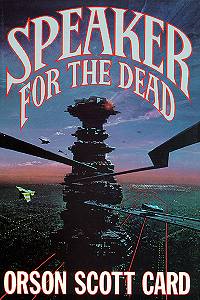 While Ender’s Game was content to focus on one person’s
development, Speaker throws the doors wide open. A dozen Ender’s Games are in
Speaker, plot-wise, and each thread is just as taught. Speaker not only works
so well with Ender, but it adds so much depth as well.
While Ender’s Game was content to focus on one person’s
development, Speaker throws the doors wide open. A dozen Ender’s Games are in
Speaker, plot-wise, and each thread is just as taught. Speaker not only works
so well with Ender, but it adds so much depth as well.
Speaker was the book Card originally had in mind when he
wrote Ender. Instead of simply picking up from where Ender left off, it leaps
three millennia into the future. On one
hand, I was hesitant to leave the familiar world of Ender behind, but the new
wonders awaiting me in Speaker coaxed me out of my shell.
Card writes characters very well, so the increased cast size
works. Andrew works his way into the family drama, telling them
what they need, not what they want. This entire plot-thread echoed so very much
of a personal Christ that I looked up the author to confirm whether or not he
was a Christian. Like Jonathan Strange and Mr. Norrel, Speaker shows that it's possible to write Christian stories without devolving into the starchy pulp that gets sold in most religious bookstores.
The mysteries do a good job of holding the plot together.
Why did Novinha marry a brute of a man instead of the one she loved? Why did
the Piggies murder two xenologers? Why does the ecology of Lusitania feature
such a sparse biological landscape? They drive the plot forward and keep
everything flowing at a good pace without seeming artificial or boring.
The mysteries resolve mostly satisfying. It was beautiful to
watch Card slowly unravel some of his delicately-wound characters so we can see
every stich and seam. The human mysteries are truly the best, while the
scientific mysteries are more flat. Perhaps this is only so because the human
stories are so rich by comparison. In retrospect, Speaker seems more about
people then about any larger sci-fi motif. Then again, perhaps this was also
true for Ender’s Game.
Besides personal drama, Speaker loves dealing with the
philosophy of aliens and intelligence. The categorizing of beings into levels
of familiarity and intelligence did a lot to facilitate the discussion of the
destruction of other species for self-preservation. It’s these discussions that
make it more then just family drama and sell the novel to the geek sci-fi
crowd. They’re some of the finest parts of the book by far.
However, the thread about the descolada virus is not quite
so good. The reveal at the end works
I suppose, but it seems far too weird for my tastes. I swallowed it regardless
and the rest of the story went down just as well.
At the end, many plot threads are left untied. I didn’t mind
it because the story was truly about Novinha and her family. These parts
resolve into satisfying conclusions, so I didn’t feel like I was taken for a
ride. Xenocide on the other hand….
Xenocide:
I dived into Xenocide right away, excited to see the larger
threats in Speaker resolve. So many juicy plot threads were left dangling to me
to resist the pull of the sequel for long. I spent half as much more time
slowly following their winding trails only to be left disappointed.
 The progression seems to flow naturally from Speaker at
first, but there’s a twist at the end that tangles everything into a nasty
knot. Xenocide first introduces the idea of Philons. If the full revelation of
the Descolada in Speaker was a bit off, Philons is full-on midichlorian weird.
If it sounds like an idea that belongs in a different series of books, it’s
because it was (but the publishers encouraged Card to merge them).
The progression seems to flow naturally from Speaker at
first, but there’s a twist at the end that tangles everything into a nasty
knot. Xenocide first introduces the idea of Philons. If the full revelation of
the Descolada in Speaker was a bit off, Philons is full-on midichlorian weird.
If it sounds like an idea that belongs in a different series of books, it’s
because it was (but the publishers encouraged Card to merge them).
The Philon idea then leads everything into a magical
dreamscape that recreates old characters from Ender’s Game and leaves you on
the promise that you get to watch them run free in the next book, Children of
the Mind. It felt unnatural and I cannot conceive of any way for the narrative
to resolve in a way that doesn’t feel fake.
I’m aware that it’s a bit awkward to end on Xenocide, when
by the authors admission, it and Children of the Mind were conceived as a
single book. I should likely finish the fourth book before making a judgment,
but I don’t care that much any more.
What started as bubbling excitement in Speaker ended in
disappointment in Xenocide. The big threats, such as the fleet destroying the
colony and the fate of the piggies have been teasing me for two whole books
without any satisfying conclusion. Someday I’ll finish what I’ve started and
perhaps learn that I was wrong again, but in the mean time, I have Steven
Erikson tickling every Post-Modern element of my brain right now. Another time,
Card. Perhaps another time.
Sep 8, 2011
Joe Svetlik: Mime Hunter: Part 2
Svetlik drove though the night in his usual silent manner. He didn’t need any radio to occupy him for the trip: just the purr of the engine and the buzzing of his thoughts. He left the scene of a job quickly; law enforcement usually didn’t appreciate his services as much as his customers.
Entering his spartan apartment, joe peeled of his wet clothes and draped them over the nearest piece of furniture. Tonight, this happened to be a battered wooden chair that had once been part of a dining room set owned by giddy newlyweds. It enjoyed being part of a happy new household. So much mirth and joy seeped into its well-polished wood grains then. The chair would often look back and ponder with pensive regret the events that led it down this road in life. It didn’t notice the wet clothes.
Svetlik walked across the room and fell into bed. Like the rest of the room, the bed matched a sparce ascetic inspired by Batman, more Nicolson then Clooney. With just a simple mattress with a heap of blankets on top, it got the job done every night without complaint.
His head smacked into the soft feather pillow with such force that it knocked the dust of the day out of his mind. It puffed out of the cracks and wrinkles in his brain and gathered into a cloud that floated before his dreaming eyes. The stoppage, having been removed, allowed the fatigue to seep out of his head, drip out of his ears, and pool into his pillow.
Though asleep, Svetlik was by no means at rest. Something about his encounter with the feral mime earlier that day struck him, and it dislodged something long tucked away, as if the librarian in his mind had wanted to hide it from the more conscious parts of his being.
Svetlik’s mind lay like a sleeping city, which is to say that the most important, productive aspects lay completely unaware while the parts with nothing better to do generally had their way. The memory had fallen down from its hiding place and now lay as a smoldering hunk of obsidian in the road. Most parts of his mind had simply walked around it as they hurried on with their urgent duties. Yet, now that the city was empty, the more subtle, subconscious parts came upon it with the full inquisitive intensity of a child that knows he’s trespassing.
They swarmed around it, feeling it out in the darkness of the night. It felt like someone standing behind you in a dark alley. It felt like the unease that seeps into your skin. It felt like frozen panic. They all scattered back into the comfort of the fetid sewers.
It was about this time that the sleeping parts of his mind rose out of their beds, muttered curses and loudly demanded to know just what was going on. Enough stayed behind for Svetlik to continue sleeping while the rest journeyed out with lights to investigate.
Memories are timeless things. This isn’t to say that they don’t have length or cannot be tied to a particular time of happening, for they usually have all these things. It means that they are experienced all at once, as if the observer existed outside of the stream of time.
So when Svetlik’s mind found the dislodged memory, he experienced it all at once. To describe it as he now felt it would be to destroy all the nuance that made it so worthy of description, much like dumping too much sugar and cream into a well-brewed cup of coffee. Instead, I’ll lay the bits and pieces out in a vague chronological order.
First, a birthday. It was his, and he was turning 10. In his mother’s eyes, the extra digit called for extra celebration. It should be noted that, despite all comments to the contrary, Mrs. Svetlik viewed the occasion as her time, not her son’s. Thus, Joe was never asked what he wished for a birthday party, or even if he wished for a party at all. Having experienced this nine previous times, Joe wasn’t surprised.
And so, when Joe later found himself sitting in the backyard, surrounded by kids he didn’t particularly like, waiting for a hired clown to arrive, he wasn’t disappointed. Due to a mix up, a mime arrived instead. Yet, even this tragedy upon tragedy did not break little Joey’s stoicism.
The performance was mundane, and only Mrs. Svetlik derived any entertainment from the event. He couldn’t make balloon animals, so instead he stood in front of them, going though his various acts: being trapped in a pretend box, pulling a pretend rope, and so on. He had a sway and stood at odd angles, like Uncle James when he arrived late to family reunions. A brief wave of panic swept across the mime’s face, as if he became decidedly claustrophobic about his pretend box. Franticly he pounded the air until it silently shattered. Stepping out, he stood, limbs bent at decidedly un-mime angles, and roared as ferociously as a lion, yet as quiet as a room after a racial slur. Spittle spattered across the horrified faces of the children.
The children, long conditioned by their schooling to accept scary authority figures with ridged stoicism, remained in their seats, gripping the bottoms of their lawn chairs. The mime closed in, yellowed fingernails clicking and clacking. Joe, however, leapt to action, his pocketknife gleaming in the summer light.
Joe placed himself between the monster and the children, his small-bladed pocketknife held at the ready. This mime looked down at him, eyes already tinting red. It batted a gnarled paw at Joe, ripping a gash up his arm. While his blood leaked, his adrenaline-fueled courage did not. Svetlik lunged.
The knife’s baptism was brief but full. Up until this point, the only blood his pocketknife had tasted came from failed attempts to whittle. Now it tasted mime-flesh, and it hungered for more.
After that, the moments became like torn scraps of a newspaper, words without much context. Screaming and sirens rang out. The police came, then left. Adults talked back and forth with the same scared tone of voice they use when discussing money. News anchors were forced to switch from their usual panic to an unnatural calm just to provide emphasis.
Nobody knew quite why it happened. Perhaps it was something in the makeup, or in the baguettes. Some even suggested that the cause lay in a communal disease that spread in mime-circles. Whatever the reason, it wasn’t an isolated incident. Now, they roamed the streets, feral. Some started to travel in gangs, filing their teeth and ambushing passersby in alleyways, trapping them in very real invisible boxes.
Meanwhile, all this hummed on in adult circles far above Joe’s head.
While his wound had closed, it had never completely healed. The flesh that grew over it was different. Pale, yet dark at the same time. The first few days his parents had feared infection. Restless nights and fevers tormented him. Then it vanished as quickly as it came. All the adult attention around him found other things to attend to, and Joe was left alone. The fever may have lifted, but the infection remained.
It stained his dreams. Every night, he became a mute, trying to scream out but failing to find words. Along with the words, objects would vanish as well, loosing their image but not their corporality. It started with small objects like cups and pencils and moved up to larger objects like walls and cars. Soon, Joe became accustomed to living in a full mime paradise every night.
Svetlik awoke violently, untwisting himself from his tangle of blankets and sitting up. The dreaming of dreams had been too much strain on his restless mind. He held his sweat-sheaved forehead in his hands and felt the throb of a headache inside. Stumbling out of bed, he fumbled for some painkillers, swallowing them dry in a swift motion.
Outside the unadorned window, the light of a full moon poured into Svetlik’s room. A shiver of fear racked his body. Not tonight, he thought. Any night but tonight.
Aug 11, 2011
Joe Svetlik: Mime Hunter Part 1
The dark sky poured itself out onto the city. It tried to wash it clean: a rain drop for every sin. Tonight was an especially heavy downpour; sins came easy on a Saturday night.
To the inhabitants, the rain was more scouring then cleansing and they sought shelter wherever they could. Most hid in their warm homes, their bodies warmed by animal-print Snuggies while their flickering televisions calmed them back into docile states.
However, all were not so lucky. Hardy Harrow was so desperate for nourishment that he would brave any celestial scouring to use his meager allotment to purchase a few packs of instant noodles. He wandered the poorly lit aisles at his local Han-Dee Mart, guided by the ancient hunter-gatherer instincts of his ancestors. While the narrow, uneven aisles and flickering, ambered lamps might disorientate an outlander, to Harrow, this was his homeland, his forest and plain. He navigated its alien landscape deftly, using what others would see as warning signs instead as landmarks. A left at the exposed wiring, past the sparking refrigerating unit, and arrive at the treasured Ramen. He had done it a million times, both while under the influence of alcohol and extreme sleep deprivation, and every time he bested his pray and carried it back to his cave for consumption.
Tonight, something shook him out of his familiarity. New instincts, long dormant, came alive again with a jolt. The hairs on the back of his neck and hands stood up, responding to the electromagnetic force of evil and danger. Whatever it was, it was close enough to sense, but not to actually see. Harrow braced himself against his materialism and slowly peered around the endcap. He dared only steal a small glance, but even that chilled him deeply. A man stood in the middle of the noodle isle, staring not at the cheap carbohydrates, but at Harrow.
His pale white face reflected the fluorescent light with a sickening tint. The stripes around his shirt were the color of despair and they looked to be prison bars despite their horizontal orientation. He wore a soulless baret, a lid to keep the evil from flying out of the top of his head. He was motionless, as if trapped in an invisible box, yet this was no consolation. This being was a mime.
Harrows blood froze in his veins. He had done many things in his life that were terrible and he made a point to regret them all whenever convenient. Yet none of them were bad enough to deserve this. A mime, a being of pure evil, stood guard in front of the ramen noodles. His mind raced for substitutes. The frozen burritos were in isle 14, those would satiate his hunger and make his slip into malnutrition that much more confortable. Slowly, he willed his muscles to movement, strand by strand pulling his away. A sudden odor filled his nose and strangled his neck with an invisible noose. It was a mixture of garlic, unfiltered cigarettes and cheap wine. The mime leered at him from around the corner, filed teeth gleaming.
It’s a rare event in the life of a college student that he utterly forgets about all the heavy responsibilities that loom above his head. In the short term, there were always papers that needed to be cribbed from other sources and reading assignments required a consultation with spark notes. In the long run, the repayment of student loans and the acquisition of a usable degree and socially productive career always remained in the back of all undergraduate minds. They might be coerced to dim this constant buzzing with various indulgences, but they were never completely silenced. Yet, in that moment, these were such minor concerns to Harry Harrow that he could have debated their existence, given the luxury. The breath of the mime, rank with French Mustard Gas, had devoured every other crisis of his life to become the very meaning of Fear.
Harrow clenched his eyes shut. This Fear was greater to Harrow than any of the existential crises he wallowed in during his college career, and he found it fascinating. He took this, his last moment, to savor the particular melancholy of Ultimate Dred. Harrow wished to have this most elusive flavor still wafting over his emotional tongue as he wondered into lands unknown. He allowed this romantic solipsism to envelope his being.
His ears heard the tinny report of an intercom. “Svetlik, code white in aisle 13. Svetlik, Code white in aisle 13.” They reported this to Harrows mind, but it did not correspond to the delicious abandon of his current despair, so it was dismissed.
When he opened his eyes, Harrow realized that he was no longer alone with Fear. A man stood a dozen paces away clad in a dripping trench coat the color of night.
“Hey, you there,” he announced. If his voice had been any more suave it would have been composed purely of sex and razor blade commercials. The mime wheeled around, upset that his meal had been interrupted. It opened its fowl mouth and gaped a silent roar at the dark stranger.
“The strong silent type, eh? Two can play at this game.” The man raised his arms to cradle an imagination weapon slung low to his waist. His arms rocked back as the imaginary weapon bucked into him. Moments later, the mime experienced a very real explosion. Harrow ducked for cover as dried noodles and mime bits rained down on his head. The better part of a beret landed smoldering at his feet.
“Tell Satan Svetlik sent ‘ya!” quipped the stranger, swaggering through the debris. He casually rested the imaginary weapon on his shoulder. The aisles had been pushed into new, crooked angles and their contents appeared as if arranged by a K-Mart stocker. The fumes of the high explosive mingled with those of the mime and together they merrily danced through the Hand-Dee Mart.
An aging man in a green grocery apron rushed to the scene. Staying a safe distance back from the impact zone, he shouted, his voice full of gratitude. “Oh, thank you sir! I don’t know what I can do to repay you, but I’ll try, I swear I’ll try!”
Svetlik halted his saunter, his combat boots imposing CLOMP CLOMP ended with an ominous SQUiissshh. Harrow couldn’t tell if he was regarding the clerk or simply staring into space, as his expression was masked by a pair of dark aviators. The moment passed and he moved on, brushing past the clerk.
He reached the front door and gave it a shove, the bell chime intonating cheerfully. “Why do you do this?” begged the clerk. Letting the door close behind him, Svetlik walked out into the downpour and halted. The rain pelted him with a thousand watery bullets, each one a cleansing salve that removed every last mime-bit. He removed his glasses and raised his face to the sky, eyes closed, and submitted to the cleansing.
Harrow watched this while still crouching in dehydrated noodle debris. He saw a heavy, black burden wash off of him in that rain. Harrow knew why the man did not accept payment for his actions. It wasn’t a commission, but a duty that brought him here. This was no exterminator that removed pests, but a hunter that bravely dispatched the beast with its own tricks. Harrows heart leapt for him. For forth, brave hunter! Clad yourself in night and defeat it! A tear came to his eyes, for it seemed that he had found a romance for his heart. What does Fear itself fear? Svetlik: Mime Hunter. But even this joy was quickly dashed by the remembrance of a Calculus quiz Harrow had in seven hours. C’est la vie…
Jul 18, 2011
White-Washing From Up High
Cross-Posted from the Examiner.
Retiree Former President Bill William J. Clinton writes in The Atlantic that were we to paint the roofs of our houses white, the energy savings would more than pay for the cost of hiring young delinquents unemployed kids to do the work. The City of New York is already paying kids to do this. Never mind the fact that they can’t find work because minimum wage laws make it illegal to do so. This isn’t just a solution to a problem made by a different program; this is “the single best idea to jumpstart job creation.”
But it continues! “Every black roof in New York should be white; every roof in Chicago should be white; every roof in Little Rock should be white. Every flat tar-surface roof anywhere!” William J. cannot contain his excitement.
Lest you think that the fun ends there, it turns out that simple white paint might absorb as much energy as black. Perhaps it’s best not to take the advice of (ex) government officials in the area of cost savings.
Jul 16, 2011
Government Math: Non-Budgetary Edition
We all know that the governments often ignore reality but they have also been known not only to oppose known mathematical facts, but also actively legislate against them, as illustrated by Indiana trying to change the value of pi to 3.2.
It starts with a Mr Edward Goodwin trying to find a square with the exact same area as a circle. Despite being proved impossible years before, Mr. Goodwin constructed a falsified proof, had it published (showing that journals, even then, were suspect in their selection), and then copyrighted it. While he wanted to extract royalties from everyone using his formula, he offered to let the state of Indiana use it for free (for educational purposes), but only if they officially recognize his impossible method as truth.
Read the rest of the story here. The best part is when it gets unanimously passed by the Indiana House.
What's more scary, the fact that 67 representatives thought they had the power to redefine mathematics, or the fact that they almost succeeded?
It starts with a Mr Edward Goodwin trying to find a square with the exact same area as a circle. Despite being proved impossible years before, Mr. Goodwin constructed a falsified proof, had it published (showing that journals, even then, were suspect in their selection), and then copyrighted it. While he wanted to extract royalties from everyone using his formula, he offered to let the state of Indiana use it for free (for educational purposes), but only if they officially recognize his impossible method as truth.
Read the rest of the story here. The best part is when it gets unanimously passed by the Indiana House.
What's more scary, the fact that 67 representatives thought they had the power to redefine mathematics, or the fact that they almost succeeded?
Jul 9, 2011
Budget Battle 2010: Or, Why I’m Not Sorry for Unions
Cross posted from Examiner.com
Over the last few months, anyone with a political inclination has been handed a rifle and filed into their respective trenches. We’ve passed talking about the issue a long, long time ago and now we’re left with the most violent of bloodless politics. While everyone talks about “the budget”, it’s not the budget that started the war: entrenched special interest did.
Budget cutting will always step on toes, but it wasn’t until the reforms started to outlaw public-sector unions that the hornets’ nest was truly stirred. That should be the first hint as to what lies at the heart of this conflict.
As far as special interests are concerned, unions are ten-ton gorillas, public unions even more so. Membership in Wisconsin is mandatory and so is the paying of dues. These dues are used to bend the political machine in their favor. Overtime pay is a great example of this. Instead of hiring more people or simply scheduling their employees properly, state institutions (especially prisons) will regularly shell out heavily for overtime pay. In 2010, overtime pay in the state reached $52.8 million. Lists are regularly published of employees who make over twice their base annual salary in overtime pay alone; simple guards and nurses making six-figure incomes. This is fiscal irresponsibility that can only be found in the public sector. This is a great reason why I’m not very broken up about the loss of collective bargaining rights for public employees.
The extreme backlash provoked by the disfranchisement of privlaged is exactly what Mancur Olson described in “The Rise and Decline of Nations”. Olson talks about how democracies slowly decline over time as they become more encrusted with special interest draining wealth and energy from taxpayers for their own personal benefit. As time goes on, these interests become so deeply rooted in the nation that it becomes impossible to root them out. Even if the reforms don’t stick over time, picking a fight with the public unions will be the last political act of Governor Walker. It’s the kind of political despair that only a student of Public Choice theory can truly appreciate.
Unions may be onerous leaches on the democratic political system, but Ross Kenyon writes that the issue of collective bargaining is more ambiguous then it seems. While the balance of power between the state and public unions may be a bit off, outlawing the unions overnight shifts the balance of power dangerously in the opposite direction.
There certainly are larger budgetary issues at stake (remember this is about the budget?) and there is no guarantee that the state won’t be heavy-handed towards its employees, but I find it hard to muster pity for their loss. These changes mostly affect workers in health and detention fields, both of which could do with a large dose of market competition. Instead of debating the proper way to regulate state monopolies, why don’t we question their existence in the first place?
Subscribe to:
Posts (Atom)